Wednesday, January 07, 2009

Surprise Day in January!

What a surprise we woke up with slight drizzle.
No DEW around.
Temperature was mild with some slight breeze blowing from NORTH.
In the morning it was partly cloudy and with some signs of MORE drizzle.
Today thru the day we recorded high humidity..at 91%
Now (4:43PM) it's drizzling mild and steady.
More drizzles and even a mild shower is forecast for late evening. And from tomorrow morning this weather pattern will slowly move away.
Going by the latest Visible & IR satellite image...

We can see some mild cloud cover can be seen over most of North-Tamilnadu and South-Andhra.
This is causing some local formations and that too weak in nature.
We can expect this weather pattern for next 24 hrs and melt away.
Latest numeric models suggest... more rain for Southern Tamilnadu.

Sunday, January 04, 2009

"Cold Wave in India Attributed to Global Warming"

'Cold Wave in India Attributed to Global Warming'
Taken from Newsbusters.org
Imagine yourself as a big time editor, and somebody brings you an article with the headline, "Cold Wave in India Attributed to Global Warming."

Wouldn't you strongly suggest a rewrite?

Well, no such sanity occurred at the Indian website Sify on Tuesday.

Instead, that preposterous title actually did get published atop an article of equally absurd and hypocritical content (emphasis added):

Story Continues Below Ad ↓

Mumbai: The recent cold wave sweeping across Mumbai and other parts of India could be attributed to global warming, experts said on Tuesday here at an environmental conference.
Addressing the ‘Combat Global Warming’ conference at the Indian Merchants Chamber (IMC) here, former Union minister for power and environment Suresh Prabhu said global warming was primarily a problem created and induced by human beings.

He said the increase in emission of green house gases like carbon dioxide, nitrogen oxide and methane had resulted in the situation, which could prove catastrophic if unchecked.

Prabhu said the cold wave that swept Maharashtra and other parts of India recently could be attributed to the phenomenon of global warming.

Astounding, wouldn't you agree?

After all, the foundation of anthropogenic global warming is that carbon dioxide placed in the atmosphere by man is exacerbating the greenhouse effect thereby making the planet heat up to dangerous levels that will melt glaciers and polar icecaps making ocean levels rise and eventually swamp coastal areas around the world.

Yet, conveniently, now that we have entered solar cycle 24, and the planet as predicted by many scientists is starting to cool, the global warming crowd is blaming it on carbon dioxide.

Which is it, folks: is carbon dioxide WARMING the planet, or COOLING it?

In the end, it's a wonderful position of infallibility these folks have created, for now regardless of what the weather does, it can all be attributed to man.

Sadly, the joke's on us, for poorly educated and biased media representatives not only don't recognize the hypocrisy in this position, but also certainly won't question it.

How unfortunate for all of us.

Cold wave in North India

Here are lots of headlines regarding "Cold" conditions in North India...
Dense fog disrupts rail traffic - December 21, 2008
Cold wave grips Bihar - December 18, 2008
Dense fog disrupts air, rail traffic in Delhi - December 30, 2008
Trains starting from Jammu cancelled - August 5, 2008
Heavy fog affects flights, train schedules in Delhi (Second Lead) - December 29, 2008
Flights, trains to and from Delhi delayed by fog (Lead) - December 29, 2008
Three die after falling off overcrowded train in West Bengal - November 19, 2008
Dense fog engulfs Delhi, hits flight, train schedules - December 29, 2008
Cold wave claims 50 lives
**********************************
New Delhi - Over 50 people have died as towns and cities in India's northern Uttar Pradesh state came under the grip of a cold wave, a news report said on Saturday.

"Over 50 deaths due to cold were recorded in hospitals across the state in the past week. Most of the victims were pavement dwellers," a government spokesperson told the Indo-Asian News Service, Ians.

The deaths were reported from districts such as Sultanpur, Banda, Jaunpur and Rae Bareli, which witnessed near-freezing temperatures.

Temperatures have plummeted as state capital Lucknow and other main cities such as Kanpur and Agra saw temperatures between 3.6 degrees celsius and 4.4 degrees celsius.

Little protection against cold
Beggars and the homeless spent the bitterly cold nights with little protection beyond plastic sheets and sacks, the reports said. They were seen lighting fires to save themselves from the bitter cold.

The thick blanket of fog disrupted air and rail traffic in the state. Even on the roads, vehicles moved slowly to avoid any accidents.

The state home department has issued orders for bonfires to be lit along roads for the homeless. It has also advised the local administrations of various districts to order the closure of educational institutions due to the extreme cold.

Indian weather officials said the cold would persist over the next few days.

"The cold spell will continue for at least another week even though the temperature could rise a little over the next 24 hours," state meteorological department director JP Gupta said.
**********************************
Chennai:
City remains mild after 2 nights of cold before 1-Jan-09.
Now the min. temperature is around 19.5°C.
For next 3 days the Max temperature will be around 29 deg and Min temperature will be around 19 deg.
Mainly clear skies and humidity around 50%, and this might go up after 48hrs.
No threat of rain and not even drizzles.

Thursday, January 01, 2009

NASA Finishes Listening For Phoenix Mars Lander

December 1, 2008 -- After nearly a month of daily checks to determine whether Martian NASA's Phoenix Mars Lander would be able to communicate again, the agency has stopped using its Mars orbiters to hail the lander and listen for its beep.
As expected, reduced daily sunshine eventually left the solar-powered Phoenix craft without enough energy to keep its batteries charged.
The final communication from Phoenix remains a brief signal received via NASA's Mars Odyssey orbiter on Nov. 2. The Phoenix lander operated for two overtime months after achieving its science goals during its original three-month mission. It landed on a Martian arctic plain on May 25.
"The variability of the Martian weather was a contributing factor to our loss of communications, and we were hoping that another variation in weather might give us an opportunity to contact the lander again," said Phoenix Mission Manager Chris Lewicki of NASA's Jet Propulsion Laboratory, Pasadena, Calif.
The end of efforts to listen for Phoenix with Odyssey and NASA's Mars Reconnaissance Orbiter had been planned for the start of solar conjunction, when communications between Earth and Mars-orbiting spacecraft are minimized for a few week. That period, when the sun is close to the line between Earth and Mars, has begun and will last until mid-December.
The last attempt to listen for a signal from Phoenix was when Odyssey passed overhead at 3:49 p.m. PST Saturday, Nov. 29 (4:26 p.m. local Mars solar time on the 182nd Martian day, or sol, since Phoenix landed). Nov. 29 was selected weeks ago as the final date for relay monitoring of Phoenix because it provided several weeks to the chance to confirm the fate of the lander, and it coincided with the beginning of solar conjunction operations for the orbiters. When they come out of the conjunction period, weather on far-northern Mars will be far colder, and the declining sunshine will have ruled out any chance of hearing from Phoenix.
************************************
Here's the last recorded weather in Phoenix's landing area:

************************************
Some images from Phoenix:


Wednesday, December 31, 2008

What You can do in OOTY?

You can enjoy the cool weather.
Travel in the Nilgiris Railway. A blue colour train with wooden coaches with stream engine and cream with wooden coaches, large windows and Aweseome journey.
Go for long walks in the chilled weather.
Visit country side and feel the real ooty weather, culture.
Dont forget to visit golf at the Gymkhana Golf course. (Only members are allowed).
Visit the Testates and Factories. There are plenty of Tea estates around the Ooty Rural & urban areas.
Visit the Mudumalai forest sanctuary. (It takes around 2 hours from Ooty)
Visit Defense Services Staff College.
Visit 6th mile and also the 9th mile (Movie shooting spots. Very calm & green area. Very peaceful area.
You can get form Fresh Carrot on the way.
************
The natural scenic beauty of Ooty or Udhagamandalam as it is called now is something that has to be seen to be believed. Situated on the Nilgiri mountain ranges as part of the Western Ghats, this hill station was developed by the British rules as their summer retreat. Ooty is called as the queen of hill stations and the place truly justifies the title. Nestled in a deep valley on the Tamilnadu side of the Western Ghats, Ooty is visited by millions of tourists every year. It is situated at a height of 1350 meters above sea level and borders the state of Kerala on the western side.

There are many wonderful tourist spots in and around Ooty and a single day is not enough to visit every one of them. There are many parks in Ooty; some famous ones are Government Botanical Garden, Centenary Rose Garden and children’s park. Talking about gardens, Ooty is the venue of the famous flower show every year in which thousands of beautiful and unique flowers are kept on display and for sale. This flower show is a truly spectacular show indeed. Right in the center of Ooty is a big lake on which you can enjoy a boat ride. Ooty is also very close to Doddabetta Peak, which is the highest point of the Western Ghats at around 2300 meters. A visit to Ooty cannot be fulfilled without a ride on the toy train. The train starts from Mettupalayam and winds its way around the Nilgiri Mountain towards Ooty and the sights on the way as it approaches Ooty will take your breath away.

Ooty is well connected by roads and the nearest regular railway station is Mettupalayam and the closest airport is Coimbatore. There is plenty of accommodation available, right from cheap budget hotels to luxurious five star hotels. The best time to visit Ooty is From March to July when the temperatures will hover between 15 degrees centigrade to 30 degrees centigrade. The winter months of September to January are very cold with temperatures sometimes nearing freezing point. One visit to Ooty is compulsory in any nature lover’s iternary.

Low temperatures thru India

Chennai:
Recorded another low temperature night.
19.4°C (6:39am)
Latest satellite image shows some activity over the South-east bay region.
And some GFS suggests, we might have some showers after 7-Jan-09 and before 20-Jan-09.
But at present we can enjoy this DRY and LOW temperatures for next 3 days.
India:
All over india is experiencing a COLD wave.
Here are the recorded LOW temperatures.
New Delhi: 8.2°C
Mumbai: 12.8°C
Kolkata: 14.4°C
Ahmedabad: 13.0°C
Bangalore: 14.0°C
Bhopal: 12.4°C
Bhubaneswar: 16.0°C
Dehradun: 6.4°C
Goa: 18.4°C
Guwahati: 11.8°C
Hyderabad: 13.9°C
Lucknow: 8.5°C
Nagpur: 11.9°C
Patna: 9.4°C
Pune: 8.6°C
Srinagar: -1.8°C
Trivandrum: 19.8°C
Shimla: 5.7°C
Ranchi: 7.7°C

Tuesday, December 30, 2008

Cyclone "Billy"

A classic Cyclone photo of cyclone "Billy", here u can see it's leaving Australia. Taken on 25-Dec-08.

Sunday, December 28, 2008

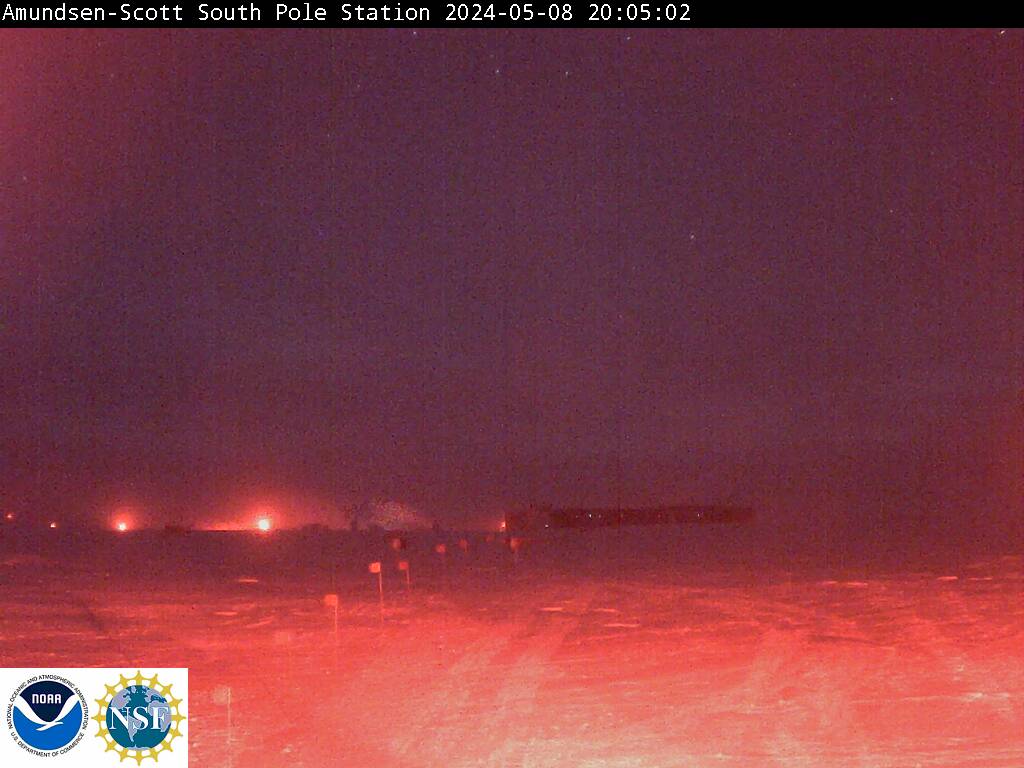
Live webcam shot from Antarctica

This photo is of the Amundsen-Scott South Pole Station taken every 15 minutes (if a relay satellite is available for transmission) from the roof of the National Science Foundation's Atmospheric Research Observatory which houses NOAA/ESRL's Clean Air Facility. In order to preserve the life of the camera, it is tilted down onto the snow when the sun is in the field of view, which occurs for several weeks around sunset (March) and sunrise (September) when the sun marches in a circle above the horizon. From mid-April until mid-August the moon and the aurora australis provide the only natural lighting. The new station can be seen to the right in the photo; the old (circa 1973) domed station is to the left. The new station is elevated above the snow to prevent it being buried by the drifting snow (the present fate of the old domed station).

Maitri - Weather sticker


alt="Click for Maitri, Antarctica Forecast" height=50 width=150>

Maitri's 'first words' from Antarctica

Taken from MSN
A member of the 27th Indian Scientific Antarctica Expedition, 56-year-old Sudhir Khandelwal, has typed, so far, 39 posts and nearly 15,000 words, with another one and a half months of his stay to go.

A consultant psychiatrist at the All India Institute of Medical Sciences (AIIMS), Khandelwal records fascinating vignettes of daily life at himalayanadventurer.blogspot.com. He writes about the effects of static electricity that result in 'powerful' handshakes, eccentric food habits, hikes on the ice shelf and the saga of a Skua bird family nesting near the station.

Khandelwal is in Antarctica for four summer months to conduct a study of short and long-term effects of extreme isolation and climatic conditions on the general and mental health on expedition members.

India's second research base in Antarctica, Maitri, is located on the rocky mountain area in the eastern part of the continent called Schirmacher Oasis, where the average annual temperature is minus 10 degrees Celsius.

Naturally, maintaining a blog is not an easy task from Maitri station, which has no direct access to the Internet. Electronic communication is limited to a single shared e-mail address, with the mails uploaded and downloaded once a day by connecting to the Amos server in the Netherlands.

So, almost every other day, Khandewal writes and mails his musings to his elder son, a computer professional in San Francisco who uploads and maintains the website.

"It's been a hobby to write my interesting experiences and travelogues to share with family and friends over email. When I was discussing with my son, Kushagra, how to reach the mailing list for sharing my experiences, he suggested the idea of starting a blog," Khandelwal told in an email interview.

With telephone calls being rather expensive, his family in India and the US find the blog the best way to ensure his well-being.

"I am usually looking at the clock when I am on the phone. His blog helps me visualise his stay in those conditions and keeps me assured of his welfare," said his wife Chitra Khandelwal, who lives in New Delhi.

Khandelwal's travel from India to Antarctica took about three days and four flights - from Goa to Mumbai, Mumbai to Johannesburg, then to Cape Town, and finally the last leg on a chartered Il-76 aircraft to a landing on the ice field at Novo air base, nine kilometres from Maitri on Nov 15, 2007.
"It looked like a huge white ocean with a tinge of blue here and there, then it looked like a white sand desert with patches of mirage appearing here and there," Khandelwal said.

As part of the summer team, Khandelwal lives in a pre-fabricated cabin with four bunker beds outside the main building. It is a rather comfortable stay with round-the-clock open pantry, a recreation room and a gymnasium.

Not surprisingly, one of the important members of the team is the station cook, Ram Das from the Indo-Tibetan Border Police (ITBP).

"Everybody tries to keep him in good humour because their health and mood depend on him," Khandewal writes, tongue-in-cheek.

From fresh fruits and vegetables at the start of the residency period, the menu moves on to food items that are frozen, tinned or powdered.

"Current fads among many of the 26th (expedition) team members are Maggie noodles and eggs. They are now sick of eating frozen vegetables and daal (lentils) for the last many months," he said.

Therefore, when visitors from the neighbouring Novolazarevskaja Russian station came to Maitri for Christmas, they brought a much-appreciated gift - fresh vegetables.

The evening hours in Maitri are often the period to hone latent talent, with the station now boasting an in-house chorus, a trio of enthusiastic party dancers, Urdu poetry aficionados, wood artists, aspiring chefs and even an amateur hair stylist. The night usually wraps up with a movie from the well-stocked DVD library.

The avenues for entertainment, however, will become wide open once the under-construction Earth Station becomes functional in March, allowing 24-hour Internet access and even beaming Indian TV channels.

"I am persuading two members who will be wintering here (spending nearly 15 months) to also start writing a blog once they start enjoying full internet connectivity and web browsing," Khandelwal told IANS.

Meanwhile, with summer nights in Antarctica always aglow with dull sunlight, a full moon night evokes a nostalgic post.

"But the full moon won't shine as it would in Delhi. It will be there in the sky but with no moonlight at all. The bright full moon from the confines of the home makes all the troubles of living in Delhi worthwhile," he said.